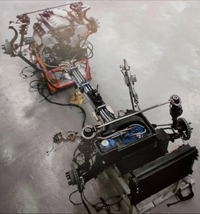
The Audi TT that almost became a Le Mans racer
We know the first-generation Audi TT as a stylish Coupé and Roadster, available with four- and six-cylinder engines and quattro all-wheel drive. What is less well known is that, in the late 1990s, Audi also experimented with a much more radical concept:
a TT with a V8 engine in a mid-engine configuration
Developed with the 24 Hours of Le Mans in mind. The project never reached the production stage, but it demonstrates just how much potential Audi saw in the compact sports coupé at the time.
More than just a design icon
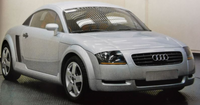
Following the launch of the TT Coupé in 1998, Audi explored various options for further developing the model. In addition to the standard Coupé and the later Roadster, consideration was also given to an exclusive version that could serve as the basis for a GT racing car. At that time, competing in the 24 Hours of Le Mans was a key strategic objective for various car manufacturers. Audi investigated whether the TT could be adapted for this purpose, not as a modified road car, but as a virtually entirely newly developed sports car utilising the familiar body style.
A completely different Audi TT
For this project, the standard TT’s technical specifications were largely set aside. The four-wheel drive was replaced by rear-wheel drive, and the familiar engines were replaced by a naturally aspirated 4.2-litre V8 with over 300 hp positioned directly behind the driver. This completely transformed the car’s character. The weight distribution, chassis and powertrain were developed with track use in mind. The bodywork was also modified to provide sufficient cooling for the mid-mounted engine.
Additional air intakes at the front, sides and rear ensured the supply and extraction of cooling air. Inside, the emphasis was on functionality, with racing bucket seats, safety belts meeting motorsport standards and other components taken directly from the world of racing.


A project behind closed doors
The development took place within a small team led by Prof. Dr Ulrich Hackenberg. Giugiaro was brought in to collaborate on the design, whilst British racing driver Richard Lloyd was also involved in the project. According to various sources, the original plan was to present the prototype as an eye-catcher at an international motor show. At the same time, it was intended to serve as a stepping stone towards a limited series of road cars that would enable homologation for the GT class. Ultimately, it never got that far.
The end of the project
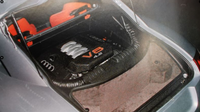
Following the construction of the prototype, testing took place at Audi’s secure test facility near Neustadt an der Donau. This revealed, amongst other things, challenges relating to the cooling of the mid-mounted V8.
At the same time, the direction of motorsport was also shifting. Audi saw greater opportunities in the rapidly growing prototype class than in the GT category and decided to invest its available expertise and resources in a new project. That decision would ultimately form the basis for one of the most successful Le Mans programmes ever.
From TT to R8R
Although the V8 TT never competed in a race, the project is regarded by experts as an important step in the development of Audi’s later Le Mans cars.
A few years later, the Audi R8R lined up on the starting grid for the 24 Hours of Le Mans. This marked the start of an impressive run of victories that would ultimately lead to iconic racing cars such as the R10 TDI, R15 TDI and R18 e-tron quattro. In that respect, the V8 TT was perhaps not a failed project, but rather a valuable test bed that helped Audi choose the right direction.
Does the prototype still exist?
Various stories about the car’s fate have been circulating for years. Within the international TT community, several enthusiasts are convinced that the prototype was never scrapped.
A well-informed TT expert confirmed in 2026 during a dinner in Ingolstadt that he had personally seen the car in the late 1990s. However, there is still no official information from Audi, meaning that for many enthusiasts, the existence of the prototype remains one of the greatest mysteries in the history of the Audi TT.
Should the car ever resurface, it would undoubtedly be one of the most remarkable discoveries relating to the TT.
© Header photo: Audi AG